How to Reduce Appointment No-Shows by 80%: A Complete Guide
Learn proven no-show prevention strategies that cut appointment no-show rates from 30% to under 5%. Covers reminders, AI-powered solutions, deposit policies, and industry-specific tactics.
The billion-dollar problem hiding in your calendar
Every empty chair, unused treatment room, and idle consultation slot tells the same story: someone booked and never showed up.
The average appointment no-show rate across service industries sits between 20% and 30%. In healthcare, it climbs as high as 42%. For beauty and wellness businesses, it hovers around 25%. Fitness studios, consulting firms, and professional services all face similar numbers.
The financial impact is staggering. The U.S. healthcare system alone loses an estimated $150 billion annually to missed appointments. A single medical practice with 30 daily appointments and a 20% no-show rate loses roughly $120,000 per year. A salon averaging $80 per appointment with the same rate bleeds $140,000 annually.
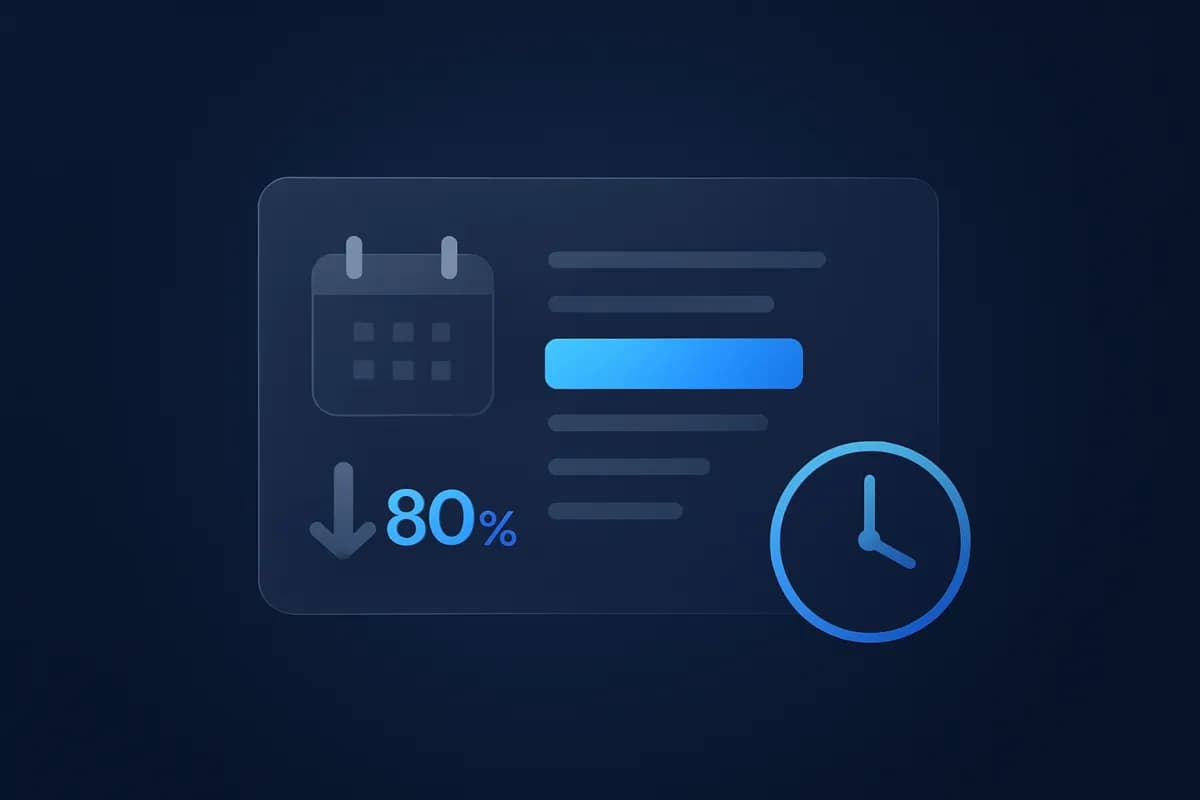
But here's the thing — these numbers aren't inevitable. Businesses that implement the right combination of no-show prevention strategies routinely cut their rates to 5% or below. That's an 80% reduction, and it doesn't require punishing your customers or overhauling your operations.
This guide breaks down exactly how to get there.
Why people no-show (it's not what you think)
Before you can reduce appointment no-shows, you need to understand why they happen. Most business owners assume customers are rude or forgetful. The reality is more nuanced.
Forgetfulness
This is the most common reason, accounting for roughly 40% of all no-shows. Life gets busy. An appointment booked two weeks ago fades from memory, especially if the customer didn't add it to their own calendar. This is the easiest cause to fix — and the one where appointment reminders best practices make the biggest difference.
Friction in rescheduling
Many customers who need to cancel or reschedule simply don't because it feels like too much effort. If your cancellation process involves calling during business hours, waiting on hold, or navigating a confusing online system, customers choose the path of least resistance: they just don't show up.
Anxiety or uncertainty
This is especially common in healthcare, dental, and new client appointments. Customers feel nervous about the visit itself, the cost, or what to expect. Without proactive communication that addresses these concerns, avoidance wins.
Booking too far in advance
Appointments scheduled more than two weeks out have significantly higher no-show rates. Priorities shift, conflicts arise, and commitment weakens with distance. Some studies show no-show rates double for appointments booked more than 14 days ahead compared to same-week bookings.
No perceived cost
When cancelling has zero consequences, the psychological weight of missing an appointment drops dramatically. There's no penalty, no lost deposit, and often no follow-up. The appointment feels optional rather than committed.
Proven strategies to reduce appointment no-shows
These are the foundational tactics that work across every industry. Implement them in order of impact.
1. Smart appointment reminders
Reminders are the single most effective tool for no-show prevention. But not all reminder strategies are created equal.
The optimal reminder sequence:
- At booking: Immediate confirmation with date, time, location, and a one-tap "add to calendar" link
- 48 hours before: First reminder via the customer's preferred channel. Include easy reschedule/cancel options
- 24 hours before: Second reminder, more urgent in tone. Request confirmation with a simple "Reply YES to confirm"
- 2 hours before: Final reminder via SMS. Short, direct, action-oriented
Channel effectiveness (ranked):
- SMS/Text: 98% open rate, 90% read within 3 minutes. This is your most powerful channel
- WhatsApp: 95%+ open rate in markets where it's dominant. Supports rich media and two-way conversation
- Email: 20-30% open rate. Good for detailed information but unreliable as a standalone reminder
- Phone calls: High effectiveness but expensive and unscalable. Reserve for high-value or high-risk appointments
Appointment reminders best practices:
- Always include a one-click reschedule option in every reminder. A rescheduled appointment is infinitely better than a no-show
- Personalize messages with the customer's name and appointment details
- Send reminders from a recognizable sender name or number
- Keep SMS reminders under 160 characters
- Include what to bring or how to prepare — this reduces anxiety-based no-shows
- Request confirmation. A two-way interaction increases commitment
Research shows that SMS reminders alone reduce no-show rates by 29-39%. Combine SMS with email and a confirmation request, and you're looking at a 50%+ reduction before implementing any other strategy.
2. Make rescheduling effortless
Every reminder you send should include a frictionless path to reschedule. The goal is to convert potential no-shows into rescheduled appointments — which retain 80% of the revenue value.
What effortless rescheduling looks like:
- One-click link in SMS that opens available time slots
- No login required
- Self-service 24/7 (not limited to business hours)
- Rebooking within the same message thread
- Automatic waitlist notification when a cancelled slot opens
When customers can reschedule in under 30 seconds, your cancellation-to-rebook rate jumps dramatically. Many businesses report that 60-70% of cancellations convert to rescheduled appointments when the process is seamless.
3. Deposit and cancellation policies
Money talks. A well-designed deposit policy is one of the most powerful no-show prevention strategies available.
The data:
| Policy | Typical no-show rate |
|---|---|
| No deposit, no cancellation fee | 20-30% |
| Cancellation fee (charged after) | 12-18% |
| Small deposit (10-20% of service) | 5-8% |
| Full prepayment | 1-3% |
How to implement deposits without alienating customers:
- Start with high-value services only. A deposit on a $200 service feels reasonable. A deposit on a $25 service may feel excessive
- Offer a clear cancellation window (e.g., "Cancel free up to 24 hours before")
- Frame it positively: "A $20 deposit secures your spot and is applied to your service total"
- Apply the deposit to the final bill — this feels like a hold, not a fee
- Be transparent about the policy at booking, not as a surprise
Deposits work because they create a psychological commitment. The customer has skin in the game. Even a small deposit shifts the mental calculus from "I might go" to "I've already paid, I should go."
4. Confirmation-based booking
Instead of assuming every booking will be honored, require active confirmation 24-48 hours before the appointment. Unconfirmed slots get released to waitlisted customers or opened for new bookings.
This approach:
- Identifies likely no-shows before the slot is wasted
- Fills gaps proactively through waitlist management
- Creates a social commitment (confirming feels like making a promise)
- Recovers revenue that would otherwise be lost
Businesses using confirmation-based booking report 15-25% reductions in no-show rates on top of reminder-based improvements.
AI-powered no-show prevention strategies
Traditional reminders and policies get you far. AI takes you the rest of the way. For a practical walkthrough of implementing AI-powered risk scoring in your business, see our guide on how to reduce no-shows by 67% with AI-powered reminders.
Predictive no-show scoring
Machine learning models can analyze historical data to predict which specific appointments are most likely to result in no-shows. The model considers:
- Customer history: Past no-shows, cancellation patterns, booking frequency
- Booking characteristics: Lead time, time of day, day of week, booking channel
- Service type: First-time vs. recurring, service value, appointment duration
- External factors: Weather forecasts, local events, holiday proximity
Each appointment receives a risk score. This enables tiered intervention — high-risk appointments get extra touchpoints (additional reminders, confirmation requests, deposit requirements) while low-risk customers enjoy a lighter touch.
Predictive scoring doesn't just reduce no-shows; it optimizes your communication. Your most reliable customers aren't over-reminded, and your highest-risk appointments get the attention they need.
Smart overbooking
Airlines have used overbooking for decades. With AI, service businesses can apply the same principle safely.
Instead of leaving predicted no-show slots empty, the system strategically double-books based on risk scores. If you have 20 appointment slots and your model predicts 3 no-shows with high confidence, you book 22-23 appointments. The math works out — and when it occasionally doesn't, you have a waitlist of customers happy to fill gaps.
Smart overbooking requires accurate prediction models. But when implemented correctly, it can recover 70-90% of revenue that would otherwise be lost to no-shows.
Personalized reminder timing
Not everyone checks their phone at the same time. AI analyzes when individual customers are most likely to read and respond to messages, then schedules reminders accordingly.
A customer who consistently opens texts at 8 AM gets their reminder at 7:55 AM. A night owl who's active at 10 PM gets theirs in the evening. This personalization can increase reminder response rates by 25-40% compared to generic scheduling.
Industry-specific no-show prevention tips
Healthcare and dental
- Send pre-appointment instructions (fasting requirements, documents to bring) with reminders — this reduces anxiety and gives patients a reason to engage with the message
- Offer telehealth alternatives for appointments where physical presence isn't essential
- Implement patient portal self-scheduling with automated waitlist management
- Track repeat no-show patients and address barriers directly (transportation, childcare, cost concerns)
Beauty and wellness (salons, spas, barbershops)
- Require deposits for services over a certain dollar threshold or duration
- Use Instagram DMs and WhatsApp for reminders — these channels feel personal, not clinical
- Offer same-day booking incentives to fill gaps from cancellations
- Build a reliable waitlist of flexible customers who can fill last-minute openings
Fitness (gyms, studios, personal training)
- Implement class capacity limits with waitlists — scarcity increases commitment
- Charge a small no-show fee for reserved spots (many studios charge $5-15 per missed class)
- Allow easy class swapping rather than simple cancellation
- Use streak tracking ("You've attended 12 sessions in a row!") to build habitual attendance
Consulting and professional services
- Send a pre-meeting agenda or preparation checklist — engaged clients show up
- Use calendar invites with video links embedded (reduces friction for virtual meetings)
- Implement a 24-hour confirmation requirement for initial consultations
- For high-value engagements, a deposit or retainer eliminates no-shows almost entirely
Measuring improvement: tracking your no-show rate
You can't improve what you don't measure. Here's how to track your appointment no-show rate effectively.
The formula:
No-show rate = (Number of no-shows / Total scheduled appointments) x 100
What to track:
- Overall no-show rate (weekly and monthly trends)
- No-show rate by service type (some services will have higher rates)
- No-show rate by booking channel (online vs. phone vs. walk-in)
- No-show rate by lead time (same-day vs. same-week vs. 2+ weeks out)
- No-show rate by customer segment (new vs. returning)
- Revenue impact (no-shows x average appointment value)
Set a baseline before implementing changes. Then measure weekly. Most businesses see the biggest improvements in the first 30 days after implementing reminders and deposit policies, with continued gains as AI-powered features gather enough data to become effective.
Realistic milestones:
- Week 1-2: SMS reminders active — expect 25-35% reduction
- Month 1: Deposit policy in place — expect 50-60% total reduction
- Month 2-3: Confirmation system and AI scoring live — expect 70-80% total reduction
- Month 3+: Optimization and fine-tuning — maintain sub-5% no-show rate
Quick-start checklist: reduce appointment no-shows this week
Not sure where to begin? Start here — in priority order:
- Enable SMS reminders at 24 hours and 2 hours before appointments
- Add one-click reschedule links to every reminder message
- Set up booking confirmations with email at the time of booking
- Publish a cancellation policy on your booking page and in confirmation emails
- Implement deposits for your top 3 highest-value services
- Start tracking your no-show rate weekly with a simple spreadsheet or your booking software's built-in reports
- Add a 48-hour reminder with a confirmation request for appointments booked more than a week out
- Build a waitlist system to fill gaps from confirmed cancellations
- Review and optimize monthly — adjust reminder timing, deposit thresholds, and communication channels based on your data
The bottom line
An 80% reduction in your appointment no-show rate isn't aspirational — it's achievable with the right combination of reminders, frictionless rescheduling, smart policies, and AI-powered prediction.
The businesses that solve no-shows don't just recover lost revenue. They run tighter schedules, deliver better customer experiences, and reduce the operational stress that comes with unpredictable gaps in the day.
Start with reminders. Add deposits for high-value services. Then layer in AI-powered tools as your data grows. An AI-powered scheduling system can handle no-show prediction, smart overbooking, and personalized reminders automatically — see RZRV's features to learn how. The math is simple: every prevented no-show is revenue recovered, a customer retained, and a slot that serves its purpose.
Your calendar shouldn't have gaps. Fix the no-show problem, and it won't.